
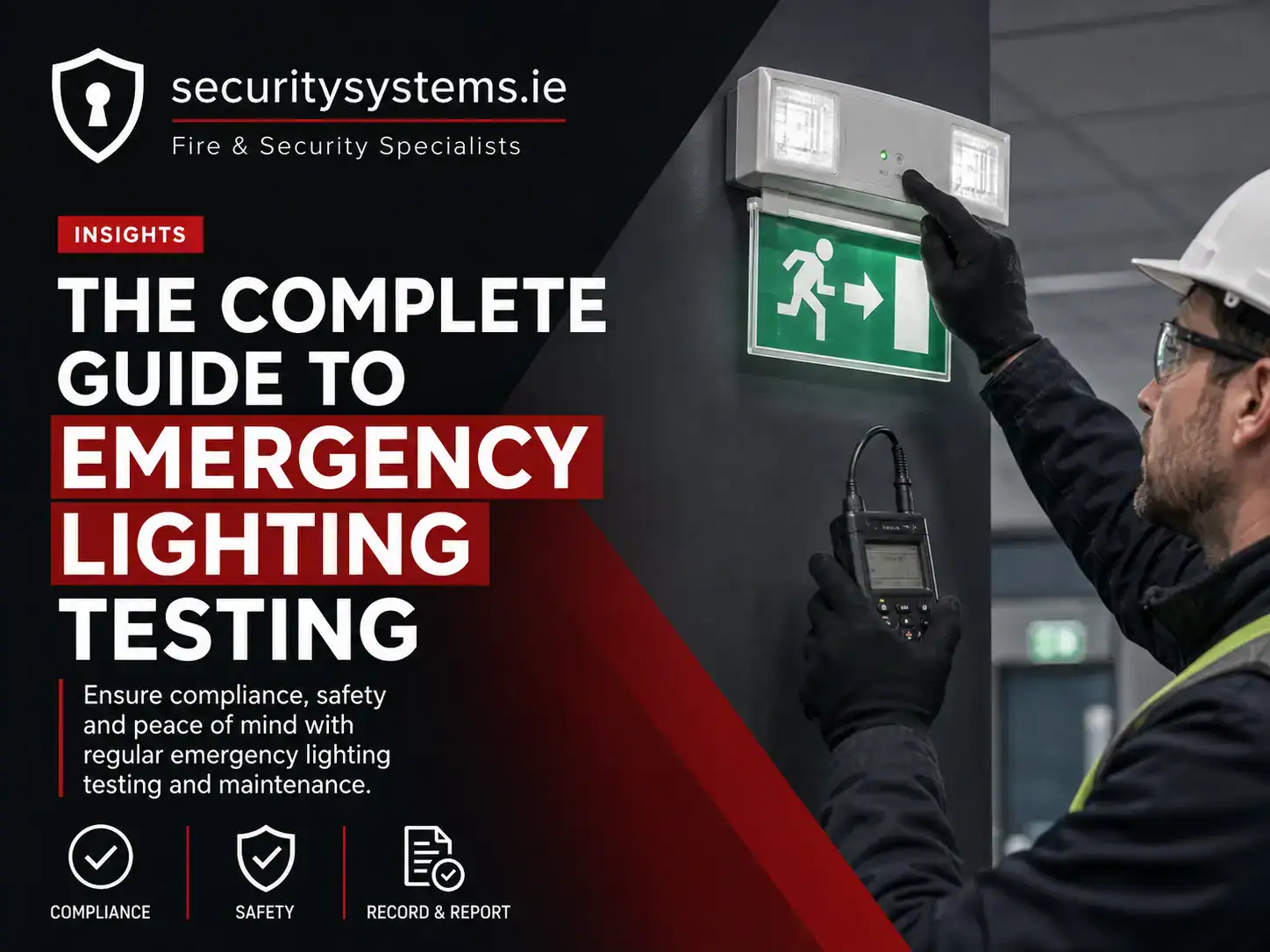
Emergency lighting is the fire safety system nobody thinks about until the power goes out. It sits on the ceiling doing nothing visible for years, and because it appears to be working, it rarely gets the scrutiny a fire alarm or an extinguisher does.
The testing regime under I.S. 3217 has four tiers, not one. Most commercial premises in Ireland carry out the easiest of them and hold a certificate for the hardest, with a gap in the middle that nobody notices until a fire officer asks to see the log book.
What the system is actually for
Emergency lighting exists to get people out of a building when the mains supply fails — which, in a real fire, it very often does. EN 1838 sets the performance target: a minimum of 1 lux at floor level along the centre line of an escape route, with at least 0.5 lux across the central band covering half the route width. Higher levels are required at changes of direction, at fire alarm call points and wherever safety equipment is located.
Those numbers matter because they are what degrades over time. A battery that holds 80% of its original capacity still illuminates the fitting — it just does not sustain the required lux for the required duration. The luminaire looks fine. It is not fine.
Fittings are either maintained, meaning they are lit continuously, or non-maintained, meaning they only illuminate when the mains supply is interrupted. Non-maintained fittings are the ones that fail silently, because nothing on the wall tells you they have stopped working.
The four testing tiers
Daily and weekly — visual checks
Indicator lamps on the fittings and on any central battery panel should show correct operation with no faults registered. On larger installations this is a walk-through rather than a formal test, but any fault indicator showing needs recording and rectifying rather than ignoring.
Monthly — the function test
Each fitting is briefly switched to battery, usually with a test key or test switch, to confirm it illuminates when the supply is cut. This is short — long enough to prove the lamp and the changeover work, not long enough to discharge the battery meaningfully.
Any lamp that fails to illuminate is replaced, and the result goes in the log book. This is the test most premises do carry out, and it is also the one that gives false confidence, because a fitting can pass a monthly function test with a battery that would last four minutes in a real evacuation.
Quarterly — the partial duration test
This is the tier that gets skipped. A three-hour rated system requires a 30-minute duration test, run on battery, confirming the fittings sustain illumination rather than simply switching on. A one-hour rated system requires a proportionally shorter test.
If your emergency lighting arrangement consists of a monthly flick test and a visit once a year, you have a gap. The quarterly test is where deteriorating batteries are actually caught, months before the annual test would have found them.
Annually — the full duration test
Once a year, the system runs on battery for its full rated duration. For most Irish commercial premises that is three hours. Every luminaire must remain illuminated to the required level for the whole period, and a formal certificate is issued on completion.
This is the test that produces the certificate insurers and fire officers ask for, and it is the one that finds the fittings that have quietly died.
The recharge window nobody plans for
Here is the practical consequence of a full discharge test that catches building managers out: after three hours on battery, your emergency lighting is flat. Depending on the battery type, full recharge takes up to 24 hours.
During that window the building’s emergency lighting provision is significantly reduced. If the mains failed that evening, the system would not deliver its rated duration.
Which is why the timing of the annual test is not a scheduling detail. It should be carried out when the building is at its lowest occupancy and lowest risk — not on a Friday afternoon in a hotel heading into a busy weekend, and not in a school during term-time hours. A competent contractor will raise this. If yours does not, raise it yourself.
Which standard applies
The current Irish Standard is I.S. 3217:2023, which supersedes I.S. 3217:2013+A1:2017. Alongside it, EN 1838 covers the lighting performance requirements and BS 5266-1 is still commonly referenced in design documentation.
As with fire alarms, if your certificates and service records still cite the 2013 edition, it is worth asking your provider when they last reviewed their documentation. It is not that a system installed to the older standard is suddenly non-compliant — it is that paperwork issued today should reference the standard in force today.
Records are the compliance evidence
A log book covering the emergency lighting system should record every test, its date, its result, any faults found and what was done about them. This sits alongside your fire register and your other fire safety documentation.
Insurers increasingly request emergency lighting test records at renewal rather than after a claim, and a certificate showing an annual test with no monthly or quarterly entries behind it tells its own story. The certificate proves the system worked on one day in twelve months. The log book proves it has been maintained.
Where buildings typically fall down
A few patterns come up repeatedly on commercial premises:
- Extensions and refurbishments — new areas built without emergency lighting extended into them, or existing fittings left covering routes that have since been reconfigured.
- Changed layouts — partitions, racking or stock changing the escape route without anyone reassessing the lighting design.
- Exit signage — illuminated signs treated as decoration rather than as part of the system, and not included in testing.
- Nobody nominated — the monthly test not being anyone’s specific job, so it happens sporadically or not at all.
The last one is the most common and the easiest to fix. The monthly function test needs a named person and a recurring reminder, or it does not happen.
A sensible starting point
Pull your log book and look at the last twelve months. If you see monthly entries and one annual certificate with nothing in between, you are missing the quarterly duration tests. If you see one certificate and nothing else, the system is effectively untested for eleven months of the year.
Neither is catastrophic, and both are straightforward to put right — but they are considerably easier to resolve before an inspection than during one.
RFC install, test and certify emergency lighting for commercial premises across Dublin and Leinster. If you want your current arrangement checked against what I.S. 3217 requires, we can do that as part of a free site survey.


