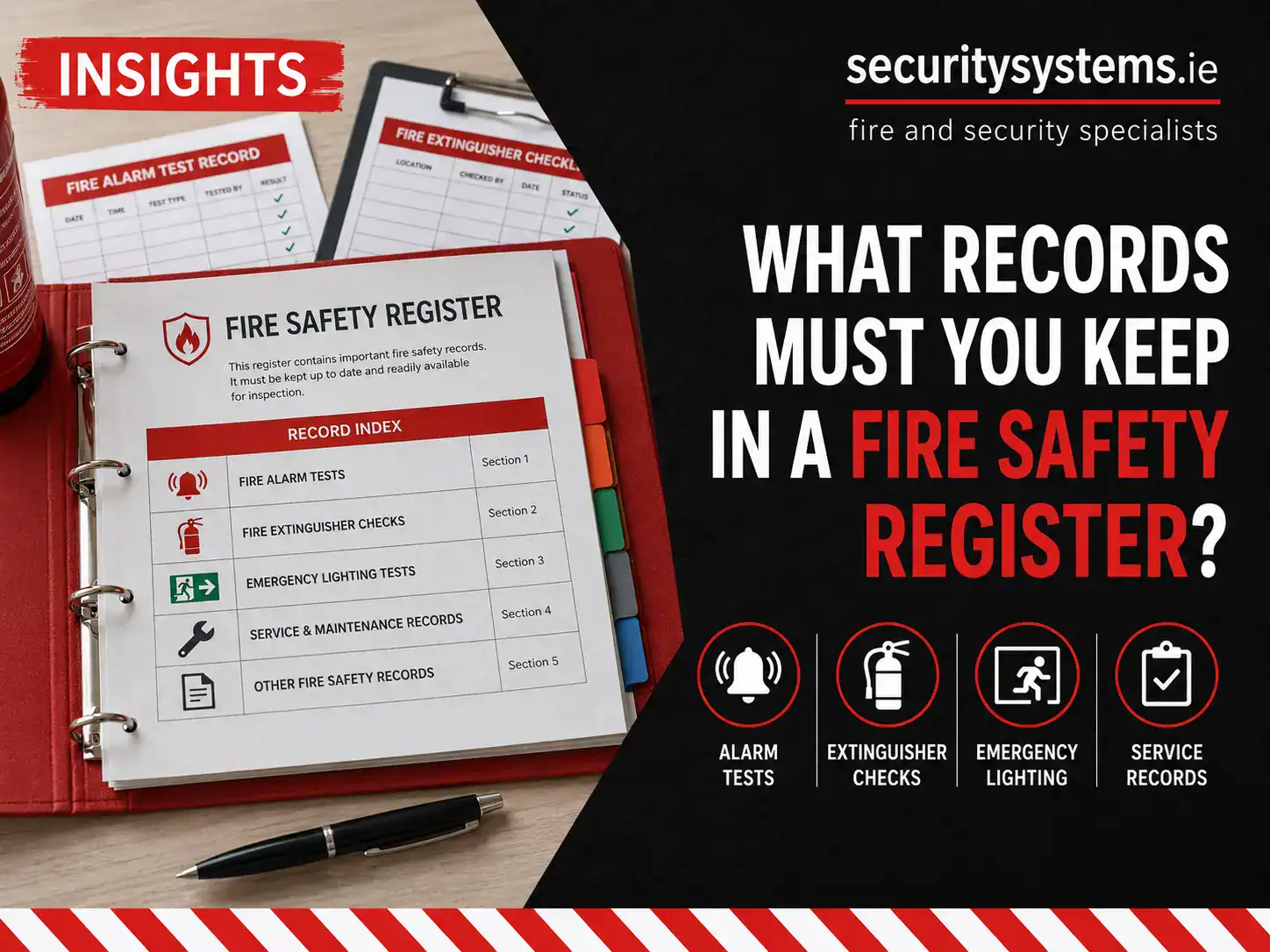
Fire safety compliance is not really about equipment. Most commercial premises have alarms, extinguishers and emergency lighting installed. What separates a building that can demonstrate compliance from one that cannot is paperwork — and specifically, whether anyone has been keeping it.
The fire safety register is where that paperwork lives. It is the single document a fire officer will ask for, and it is the one most premises cannot produce in a usable state.
The duty it evidences
Section 18(2) of the Fire Services Acts 1981 and 2003 places a duty on every person having control over a premises. In summary, that person must take all reasonable measures to guard against the outbreak of fire, provide reasonable fire safety measures and prepare appropriate fire safety procedures, ensure those measures and procedures are applied at all times, and ensure as far as is reasonably practicable the safety of people on the premises in the event of a fire.
The section applies to all premises other than a dwelling house occupied as a single private dwelling. There is no small-business exemption and no threshold below which it stops applying. If you control a commercial premises, it applies to you.
Note the wording of the third duty: applied at all times. Not installed. Not certified once. Applied continuously — which is precisely what a register is designed to evidence.
Who “the person having control” actually is
This trips people up in leased and multi-tenant buildings. Control is a practical question rather than a purely contractual one, and it can sit with an owner, a managing agent, a head tenant or an occupier depending on the arrangement — sometimes split between them.
The failure mode is predictable. The landlord assumes the tenant handles fire safety within the demise, the tenant assumes the landlord handles it because it is in the service charge, and the alarm system that covers both is serviced by nobody. Worth establishing in writing who holds which duty, before it matters.
What the register should contain
Local authorities across Ireland publish fire safety register templates, and while the formats vary the content is consistent. A register should cover:
- Fire safety training and drills — who was trained, when, on what, and records of evacuation drills including how long evacuation took and any problems encountered.
- Fire detection and alarm system log book — weekly call point tests, servicing visits, faults, disconnections and any alterations to the system.
- False alarm register — kept separately, because patterns in false alarms are diagnostic rather than merely annoying.
- Emergency lighting inspection records — monthly, quarterly and annual tests, plus an inventory of the fittings themselves.
- First aid firefighting equipment — monthly visual checks on extinguishers and annual service records.
- Daily inspection of escape routes — confirming exits are unobstructed and final exit doors open.
- Fire resisting doors — inspection records covering closers, seals, gaps and damage.
- Furniture and fittings — compliance records for upholstered furnishings, particularly in hospitality and healthcare.
Beyond those, it is usually appropriate to hold certificates for electrical and gas installations, and in premises with sleeping accommodation, records covering bedding and mattresses.
The register is not itself the law
Worth being precise about this, because it is often overstated. The Fire Services Acts do not mandate a document called a fire safety register. What they mandate is the underlying duty.
The register is the recognised and accepted method of demonstrating that you have discharged it. Local authorities publish templates precisely because a structured register is the practical answer to “show me”. You could theoretically evidence compliance some other way. Nobody does, because nothing else works as well under inspection.
The daily and weekly entries matter most
Annual service certificates are easy. A contractor visits, does the work, issues the certificate, and it goes in the folder.
The entries that reveal whether fire safety is actually being managed are the routine ones: the daily escape route check, the weekly fire alarm call point test rotating through zones, the monthly extinguisher visual inspection. These require somebody on site to do something small and repeatedly, and they are where registers fall apart.
A register with twelve months of contractor certificates and no in-house entries tells an inspector that fire safety is something the building buys rather than something it does. That is a meaningfully worse position than a slightly untidy register with consistent weekly entries in it.
Recording problems is not self-incrimination
There is an instinct to keep registers clean — to leave out the faults, the failed tests, the drill that took eleven minutes. It is exactly the wrong instinct.
A register showing a fault found, reported and rectified within a week demonstrates a functioning fire safety management system. A register showing nothing ever going wrong across two years demonstrates that nobody is really looking. Inspectors know which one they are reading.
What matters is the loop closing: defect recorded, responsible person notified, action taken, date completed.
What happens when it is not there
Under the Fire Services Acts, a fire authority can categorise a building as potentially dangerous, and can serve a fire safety notice restricting or prohibiting its use until works are carried out. That is the serious end, and it is rare.
Far more common are the practical consequences. Insurers request fire safety records at renewal and can decline cover or reduce a settlement where maintenance has lapsed. Tender processes, particularly public sector, routinely request servicing records at pre-qualification. Sector regulators — HIQA in healthcare, for instance — expect them as a matter of course. And a purchaser’s solicitor will ask for them during due diligence.
Getting one started
If you do not currently keep a register, the starting point is not buying a folder. It is establishing what fire safety measures your premises actually has, which is what a fire risk assessment is for. The assessment tells you what needs recording; the register records it.
From there it is mostly about assigning ownership. A register with no named person responsible for it becomes a drawer full of certificates within about four months. Someone has to own the weekly test, and someone has to notice when it has not happened.
RFC service fire alarms, extinguishers, emergency lighting and PAT testing for commercial premises across Dublin and Leinster under a single contract, with certification issued for each. If your records are scattered across several providers and you are not sure what you are missing, we can review it as part of a free site survey.